
Contents
The first time people see GyroStim, they usually ask two things. What is that chair, and is it for someone like me?
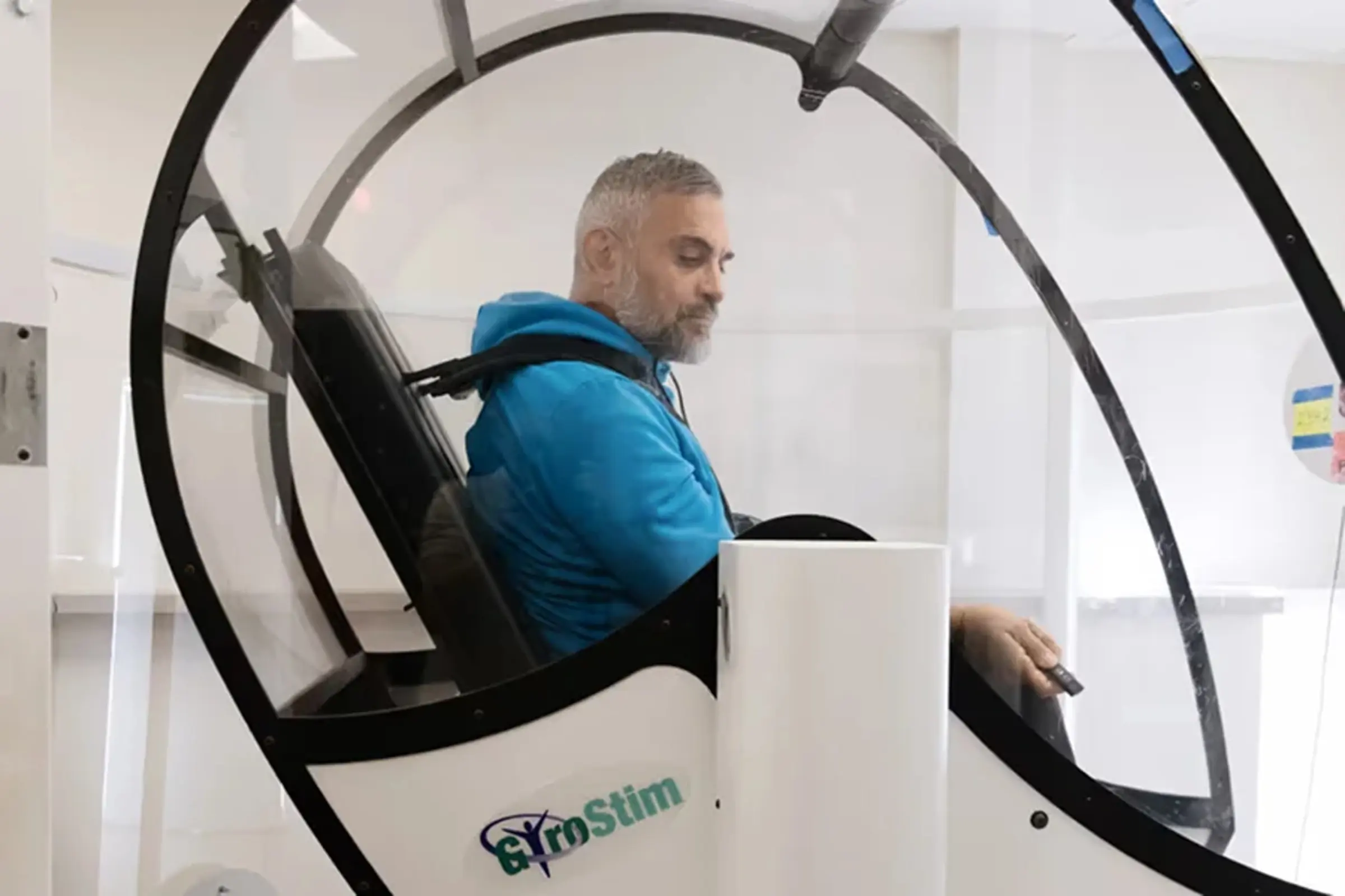
GyroStim is a motorized chair inside a rotating frame. It turns you through controlled motion while you hit targets, so your balance system, eyes and body have to work together. We use it in GyroStim sessions at our Rancho Santa Fe office, only after a full exam.
This guide explains how the chair works, who tends to be a good fit, who should wait, and what the research does and does not show yet.
What is GyroStim?
GyroStim is a computer-controlled, multi-axis rotational chair. A seated, secured patient is turned through programmed rotations while aiming a laser pointer at lit targets. The motion challenges the inner-ear balance system and vision together, so the brain practices taking in motion and responding with accurate movement.
The chair sits in a frame that can rotate in two directions: pitch, like nodding forward and back, and yaw, like turning left and right. Computer-driven motors run preset motion profiles, so each run can be repeated or adjusted precisely.
Models with a laser-target option add a task. You point at lights as they appear, and the system records how accurately you hit them.
The chair's design, clearance and intended use are listed in the FDA 510(k) record for GyroStim.
How does a GyroStim session work?
A session usually lasts about 30 minutes and is made of several short runs. Your exam sets the starting direction, speed and length of each run. The system records your accuracy, and the next run is raised, held or lowered based on how you responded.
Sessions start at or below what your brain handles comfortably now. The goal is steady challenge, not a flare of symptoms.
- Your exam sets the first motion profile and target task
- You sit secured in the chair while it rotates
- You aim a laser pointer at lit targets during each run
- The system records accuracy, and the next run is adjusted
Why train the balance system with motion?
Balance depends on three sources of information reaching the brain: your eyes, the vestibular system in your inner ear, and sensors in your muscles and joints. The inner ear has fluid-filled canals that sense rotation and small organs that sense which way is down.
After a head injury, or with some inner-ear problems, these signals can stop agreeing. The room may seem to tilt when you turn your head, or a busy store may leave you dizzy and drained.
Balance exercises train the brain to bring those signals back into line. GyroStim adds measured, whole-body rotation to that work. It asks the brain to match what the inner ear feels with what the eyes see, run after run, at a level set for you.
How the eyes, inner ear and body sensors share the work of balance is explained in the National Institute on Deafness and Other Communication Disorders guide to balance disorders.
Who is GyroStim for?
GyroStim tends to suit people whose exam shows a balance, motion or visual-motor problem. That includes dizziness that keeps returning, unsteady balance, motion sensitivity and slow reactions. It also suits athletes who want to train balance and reaction time under motion.
- Dizziness or a spinning feeling that keeps coming back
- Unsteady balance or poor coordination
- Motion sensitivity in cars, crowds or on screens
- Slow reactions or trouble tracking moving objects
- People working to regain balance, coordination, and movement after a head injury, often in coordination with their medical providers
- Athletes training balance and reaction time under motion
Who should wait or skip it?
GyroStim is not the first step for a new or worsening problem. A head injury needs to be checked by a physician first, and sudden new weakness, confusion or a worsening headache calls for emergency care. The chair also has a 400-pound weight limit.
- A head injury that no physician has checked yet
- Symptoms that are getting worse, not better
- A new injury or recent surgery
- A doctor's advice to avoid fast or spinning motion
- Body weight over the chair's 400-pound limit
Keep in mind
If anything on this list applies, we check with your physician before any session.
Can children and teens use GyroStim?
We work with kids of all ages. With a parent's written consent, the level of GyroStim stimulation is set to the young patient's symptoms and to the results of their first and follow-up evaluations.
Parents take part in the full evaluation. For young athletes, GyroStim is one part of a structured plan that aims to get them back to their sport safely and with confidence.
What does the research say about GyroStim?
GyroStim is cleared by the FDA through the 510(k) process. Exercise-based vestibular therapy in general has strong research support for easing dizziness and improving gaze and balance in people with inner-ear weakness. Independent, published research on the GyroStim chair itself is still limited.
That gap shapes how we use it. GyroStim is never the whole plan, results are measured on every run, and your symptoms are re-checked as you go. If the data and your symptoms stop improving, we change the plan or tell you GyroStim is not the right tool.
Keep in mind
GyroStim's FDA clearance covers balance disorders and vestibular dysfunction; other uses described here fall outside that clearance.
The evidence for exercise-based vestibular therapy is summarized in the 2022 clinical practice guideline on vestibular rehabilitation.
Why is GyroStim only at our Rancho Santa Fe office?
The chair is available at our Rancho Santa Fe office only, at 18029 Calle Ambiente, Suite 507, in Cielo Village. Our Newport Beach office does not offer it.
True Performance is listed in the official GyroStim provider directory. Dr. Jeff McWhorter, D.C., sets each GyroStim protocol after a detailed evaluation, exam and review of the injury and history.
Current listings appear in the official GyroStim provider directory.
Is GyroStim right for you?
GyroStim is a precise way to train balance and motion processing, used as one part of a plan built on your exam. It suits people whose dizziness, balance or reactions hold them back, and it is not a first step for a new or worsening injury.
To find out whether it fits, read how GyroStim fits into a measured balance plan. It sits within our chiropractic-based brain and balance rehabilitation in Rancho Santa Fe.
Frequently asked questions
Is GyroStim like a roller coaster?
Not really. The chair moves slowly and predictably at first, and every run is set below what you can handle now. Some motion is part of the training, and we lower the challenge if symptoms climb.
How long is a GyroStim session?
About 30 minutes, made up of several short runs with breaks between them. Your first visit is longer, because it includes the full exam that sets your starting level.
Is GyroStim FDA approved?
GyroStim went through the FDA's 510(k) clearance process, which is different from drug approval. Its clearance covers balance disorders and vestibular dysfunction, and it is a prescription device used in a clinic.
Can I use GyroStim at the Newport Beach office?
No. GyroStim is available at our Rancho Santa Fe office only. Many of our other services are offered at both offices, so ask on your intro call.
Who decides how many sessions I need?
Dr. Jeff McWhorter, D.C., sets your GyroStim protocol after a detailed evaluation, exam and review of your injury and history. We re-check as you go and adjust the plan to your results.
See whether GyroStim fits your goals
Start with a complimentary 15-minute call with our team.