

Cruises and boat trips
Sea travel is the most common trigger. The body adapts to the waves, then struggles to readapt on land.
The trip ended days or weeks ago, yet you still feel the rocking. We test how your balance and vision handle motion and stillness, then build a plan in coordination with your physician.
The short answer
Mal de Débarquement syndrome (MdDS) is a rare balance disorder that leaves a rocking, swaying or bobbing feeling after a cruise, flight or long drive. At True Performance in Rancho Santa Fe, CA, we test balance, visual tolerance and focus, then use GyroStim and TransLingual NeuroStimulation (TLNS) with guided balance and visual exercises, paced to your symptoms.
Overview
Most people get their land legs back within a day or two. With MdDS, the rocking stays, sometimes for weeks or months.
It often feels worse when you stand still or lie down, and oddly better in a moving car. Screens, busy stores and long meetings can wear you out.
No single test confirms MdDS, so your physician first rules out other causes. We then measure how your balance, eyes and focus respond to motion and to stillness.
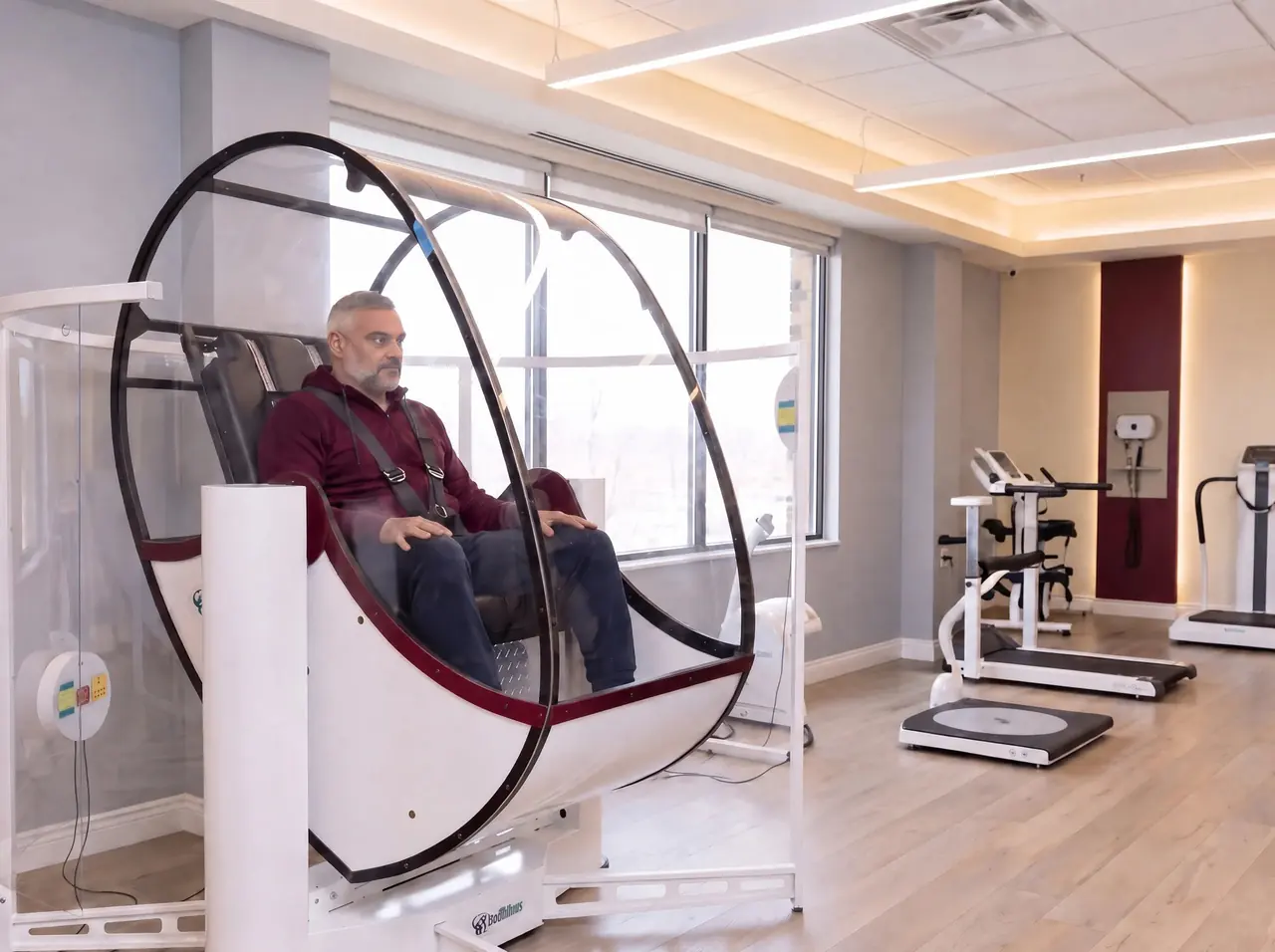
That exam tells us whether GyroStim training for the rocking sensation fits, and how gently to start.
Understanding
Mal de Débarquement syndrome, or MdDS, is a rare vestibular disorder that makes you feel you are moving when you are not. It usually starts after travel, especially by boat. The rocking often eases during passive motion, such as a car ride, then returns when you stop.
Long travel trains the brain to expect constant motion.
Back on land, that adjustment does not switch off as it should.
The brain keeps sensing a rocking motion that has already stopped.
The re-check
We re-test your balance, visual tolerance and symptom levels as you go. If they stop improving, we change the plan or point you back to your physician.
Nobody knows for sure yet. Researchers are studying how the brain combines signals from the inner ear, eyes and body after long travel, and why that readjustment stalls in some people.
It does not necessarily mean the inner ear is damaged, and standard ear tests are often normal.
Source: Cleveland Clinic's guide to Mal de Débarquement syndrome.
Symptoms
Causes
Sea travel is the most common trigger. The body adapts to the waves, then struggles to readapt on land.
Air travel and extended car or train trips can trigger MdDS less often.
Elevators, docks, water beds and virtual reality goggles have all been linked to it.
Some people develop it with no motion trigger, for example after childbirth, surgery or head trauma.
MdDS is more common in people with migraine. Symptoms can also shift with hormonal changes in some women.
Our approach
Our MdDS rehab watches how your symptoms change with controlled motion, visual work and stillness, then chooses tools to match. Care can combine GyroStim and TransLingual NeuroStimulation (TLNS) with guided balance and visual exercises, paced to your tolerance and coordinated with your physician.
Rancho Santa Fe only
MdDS responds differently to motion and to stillness. In the chair we can vary direction, speed and visual focus while watching how the rocking changes, and keep each run inside your tolerance. Learn about computer-controlled rotation for balance problems.
Gentle pulses through a small device on the tongue are paired with balance, eye-movement and movement tasks. See how TLNS balance and movement sessions are set up.
Red flags
The rocking of MdDS is steady and familiar. Some new symptoms point to a different problem that needs prompt care.
If rocking or dizziness comes with weakness, slurred speech, a drooping face or a sudden severe headache, call 911 or go to the emergency room.

Your clinician
Your care is planned by Dr. Jeff McWhorter, D.C., a chiropractor whose practice focuses on functional neurology, concussion rehabilitation, and performance. His work includes complex balance problems such as MdDS.
He looks at how your balance, vision and focus respond to motion and to stillness. Then he builds a plan around the situations that bother you most, such as standing in line, reading or a long meeting.
Visit
Our office is at 18029 Calle Ambiente, Suite 507, in Cielo Village, Rancho Santa Fe, about two miles from Lake Hodges. Patients come from across San Diego County and beyond, and we share practical tips for traveling to your visits.
The first step
For most people, the rocking fades within a day. Most others improve within a year, though some have symptoms for months or even years.
Relief during passive motion, followed by a return once you stop, is one of the signs that sets MdDS apart from other balance problems. Tell your physician about it.
No. Nausea during travel from motion sickness usually stops soon after the motion ends, and it gets worse in motion. MdDS starts after you stop moving and eases in motion.
Usually not. Some physicians use migraine, anxiety or sleep medicines when those fit, and that decision stays with your physician.
Fatigue, stress, poor sleep, long screen time and busy visual settings bother many people. A simple symptom diary helps you and your physician spot your own triggers.
We explain cost and payment options on your intro call, before you book an exam. The total depends on your exam and how many sessions your plan needs.
Journal

Start with a complimentary 15-minute call with our team.