

Falls and accidents
A fall, collision or sudden impact can injure muscles, ligaments, joints or nerves. Stiffness often shows up hours later.
A fall, a hard workout or an awkward lift can stop your week cold. We check what was injured, flag anything that needs a physician first, and help you move again.
The short answer
Acute pain is pain that starts suddenly, usually after an injury, strain or impact, and eases as the tissue heals. At True Performance in Rancho Santa Fe, CA, we examine the injured area and check for signs that need imaging first. Then we use Class IV laser therapy, PEMF therapy, nerve stimulation and chiropractic care to help you move comfortably.
Overview
You tweaked your back lifting a suitcase, or rolled an ankle on the trail. It felt manageable at first, then swelling and stiffness set in overnight.
That delay is common after a strain or impact. Most acute pain eases as the tissue heals, while pain that worsens or keeps limiting you deserves a closer look.
We ask how it happened, where it hurts and what makes it worse. We check joint motion, muscle response, balance and signs such as swelling, weakness or numbness.
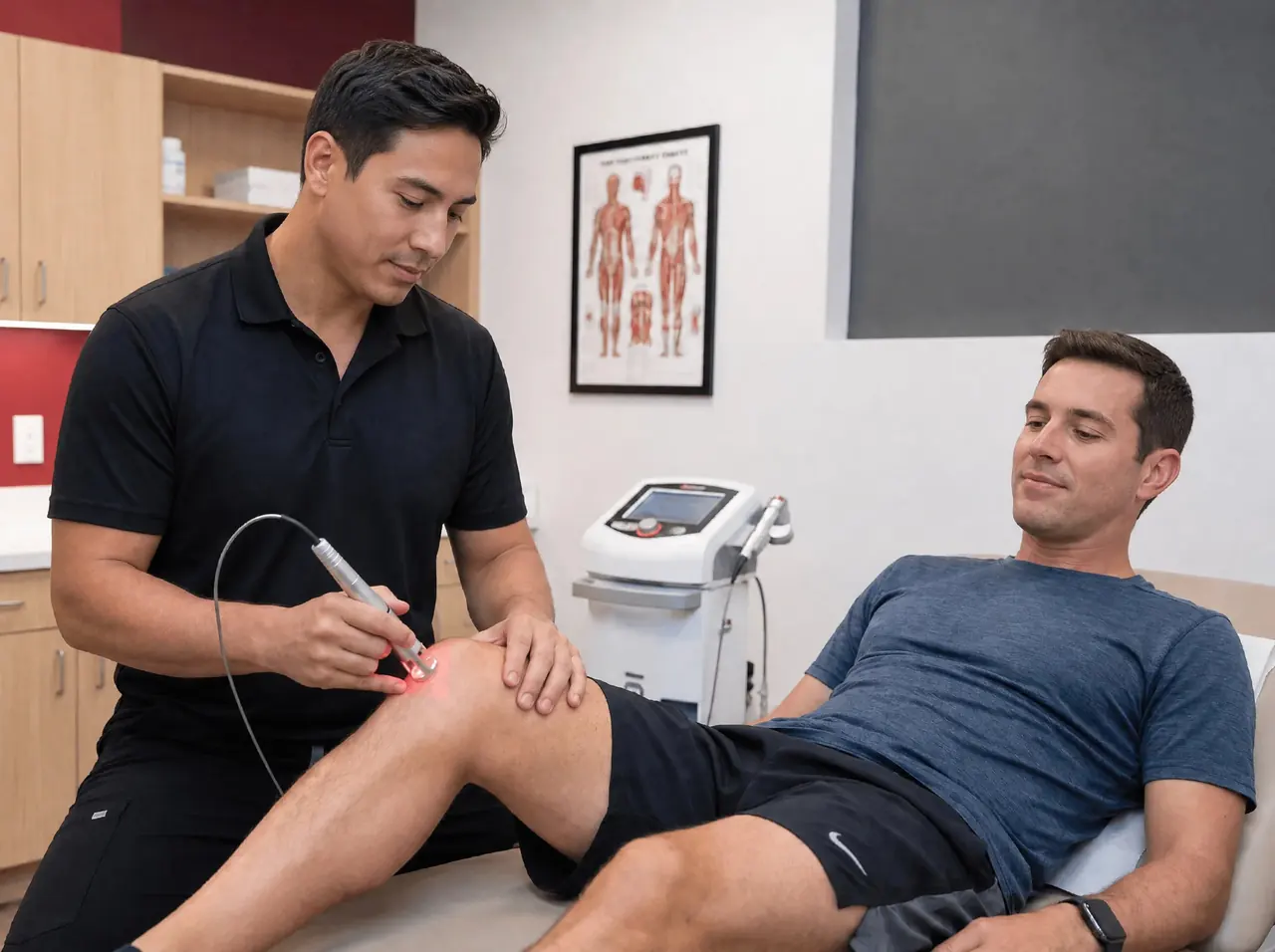
If the injury looks stable, we build a conservative plan, often starting with laser therapy for a new injury. If it needs imaging or medical care first, we tell you.
Understanding
Acute pain is pain that starts suddenly and usually has a clear trigger, such as a fall, a sports injury or a strained muscle. It tends to ease as the injured tissue heals. When it lingers, it can turn into chronic pain, so pain that is not improving deserves an exam.
A fall, twist, impact or overload injures the tissue.
Swelling, soreness and guarding protect the area.
Pain eases as healing progresses under the right load.
The re-check
We re-check motion, strength and swelling as you recover. If the area is not progressing as expected, we refer you for imaging or a medical opinion.
Acute pain usually fades once the cause heals, but it can sometimes last and turn into chronic pain, as Cleveland Clinic's explanation of acute and chronic pain notes.
Symptoms
Causes
A fall, collision or sudden impact can injure muscles, ligaments, joints or nerves. Stiffness often shows up hours later.
Quick cuts, contact, awkward landings and sudden jumps in training can cause sprains and strains.
Heavy lifting, forceful movement or unfamiliar exercise can overload a muscle or tendon.
A direct hit or forceful twist can leave a joint tender, swollen and hard to move.
Our approach
We treat acute pain by first confirming the injury is stable enough for conservative care. Then we choose from Class IV laser therapy, PEMF therapy, peripheral nerve stimulation and chiropractic adjustments, adapted to how sensitive the area is and how far recovery has come.
Concentrated light is aimed at sore muscles, tendons, ligaments or the tissue around a joint. It is not a promise of a set healing time. See Class IV laser therapy after a fresh strain.
For a new back or neck strain, gentle adjustments, joint mobilization and movement guidance aim to ease restriction. Learn about gentle spinal adjustments after a sudden strain.
Short electromagnetic pulses are directed at the injured region, with no needles and no force. Explore PEMF therapy for a recent injury.
When an injury irritates a nerve and brings burning or tingling, controlled electrical input targets the affected pathway. See peripheral nerve stimulation for sharp new pain.
Red flags
Some injuries need a physician or an emergency room before anything else.
If you notice any of these, call 911 or go to the emergency room first.

Your clinician
Dr. Jeff McWhorter, D.C., a chiropractor whose practice focuses on functional neurology, concussion rehabilitation, and performance, leads your exam. He checks the injured area and the movements around it, since a sore knee can change how your hip and back work.
With chiropractic care, laser, PEMF and nerve stimulation under one roof, we use only the services your exam supports and leave out the rest.
Visit
We are at 18029 Calle Ambiente, Suite 507, in Cielo Village, Rancho Santa Fe, near Lake Hodges and the San Dieguito River Park. Athletes and active adults come in from across North County San Diego. Call (858) 285-0073 to ask about the next available exam.
The first step
Acute pain starts suddenly, often after an injury, and eases as you heal. Chronic pain lasts longer than three months or past the usual recovery time, as described on our page about pain that has lasted past three months.
Book an exam when pain limits movement, disturbs sleep, keeps getting worse or comes with swelling, weakness, tingling or numbness. Severe trauma, a deformity or an inability to bear weight need emergency care.
A sprained ankle, a strained back muscle and a sore shoulder after a fall are common examples. Burns, dental work and recovery from surgery also cause acute pain, though we focus on muscle and joint injuries.
Somatic pain comes from the skin, muscles, joints or bones. Visceral pain comes from internal organs, and neuropathic pain comes from irritated or damaged nerves.
We explain cost and payment options on your complimentary intro call, before you book an exam.
Start with a complimentary 15-minute call with our team.