
Falls
Falls are the most common cause of TBI, especially among young children and older adults.
The emergency is over, but memory, balance, focus or stamina still feel different. We work on the function that remains affected, in coordination with your medical team.
The short answer
A traumatic brain injury is a disruption of brain function caused by a blow, jolt or other outside force. At True Performance in Rancho Santa Fe, CA, we help people working to regain balance, coordination, and movement after a stroke or head injury, often in coordination with their medical providers, using GyroStim, neurofeedback, qEEG brain mapping, cognitive training and TLNS.
Overview
You may look fine to everyone else. Inside, conversations are harder to follow, busy places wear you out, and your balance or memory is not what it was.
These effects often show up in daily tasks long after the hospital. That is where our work begins.
We see people after urgent care is complete and restrictions are set. Our exam finds which systems are still struggling, and we retrain them with tools such as GyroStim training for balance after a brain injury, coordinated with your physician and therapists.
Understanding
A traumatic brain injury, or TBI, happens when an outside force such as a blow, jolt or fall disrupts how the brain works. It ranges from a concussion, the mild form, to moderate and severe injuries that can affect movement, memory, communication and behavior for months or longer.
A blow or jolt moves the brain inside the skull.
Nerve fibers and small blood vessels can be stretched, bruised or torn.
Thinking, balance, mood or movement stop working as smoothly.
The re-check
We repeat the same balance, visual and thinking measures as you go. If progress stalls, we change the plan or send you back to your physician.
A concussion is a mild traumatic brain injury, but not every brain injury is a concussion. Moderate and severe injuries usually need hospital care and a team of therapists first, so a concussion and a severe injury never follow the same plan.
Symptoms
Causes
Falls are the most common cause of TBI, especially among young children and older adults.
A collision can whip the head sharply without it striking anything.
Collisions, hard landings and equipment impacts can cause a TBI. An athlete with a suspected head injury should stop and be checked.
Work accidents, falling objects and assaults can injure the brain without leaving a visible mark.
Our approach
Our rehab after a traumatic brain injury measures which functions are still off, such as balance or visual tracking, then retrains them. Care can combine GyroStim, neurofeedback guided by a qEEG brain map, DynaVision cognitive training, TLNS and peripheral nerve stimulation, paced to your tolerance.
Rancho Santa Fe only
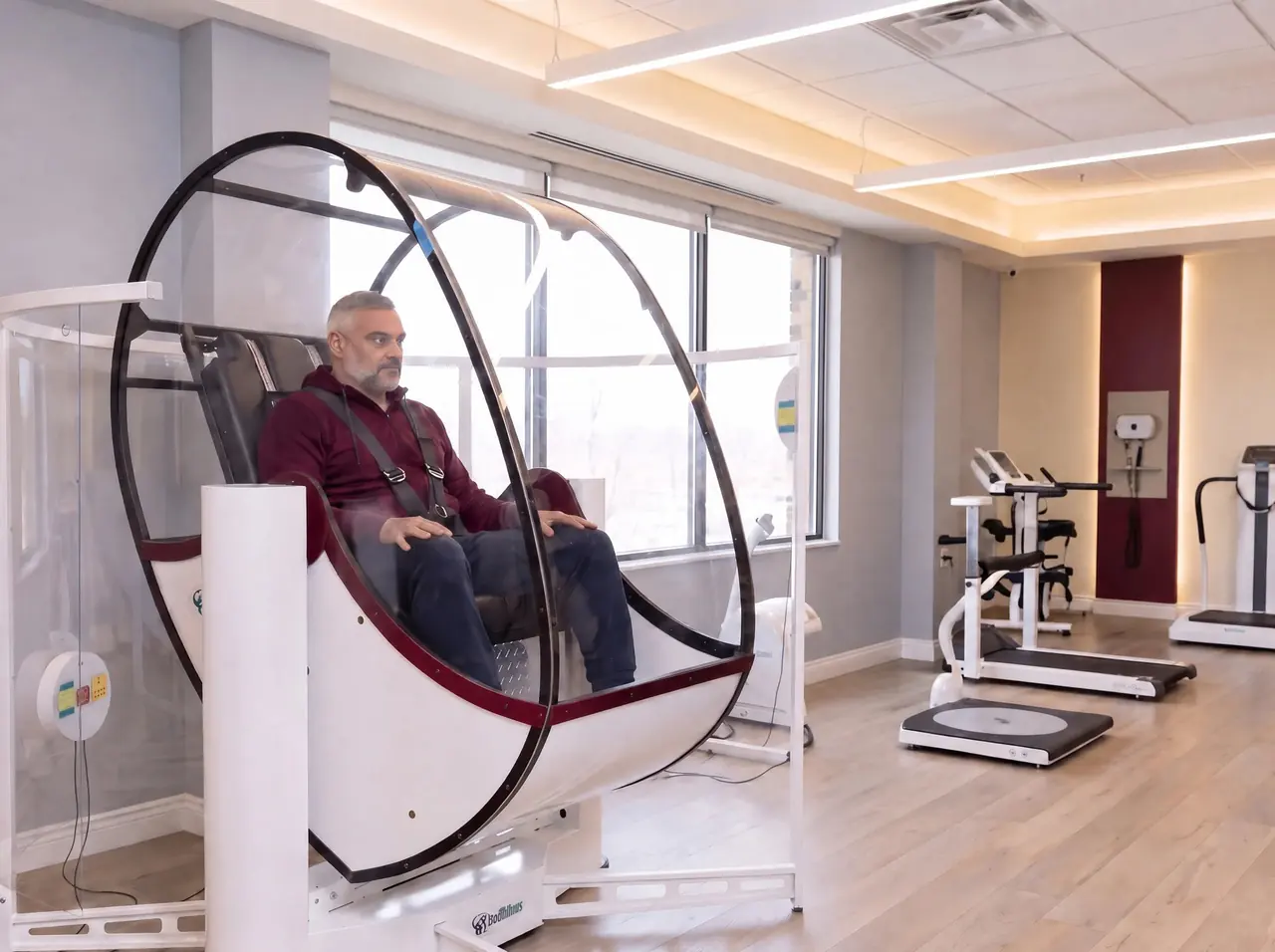
A computer-controlled chair adds measured rotation and visual targets for balance and eye-head coordination. See measured motion training in the GyroStim chair.
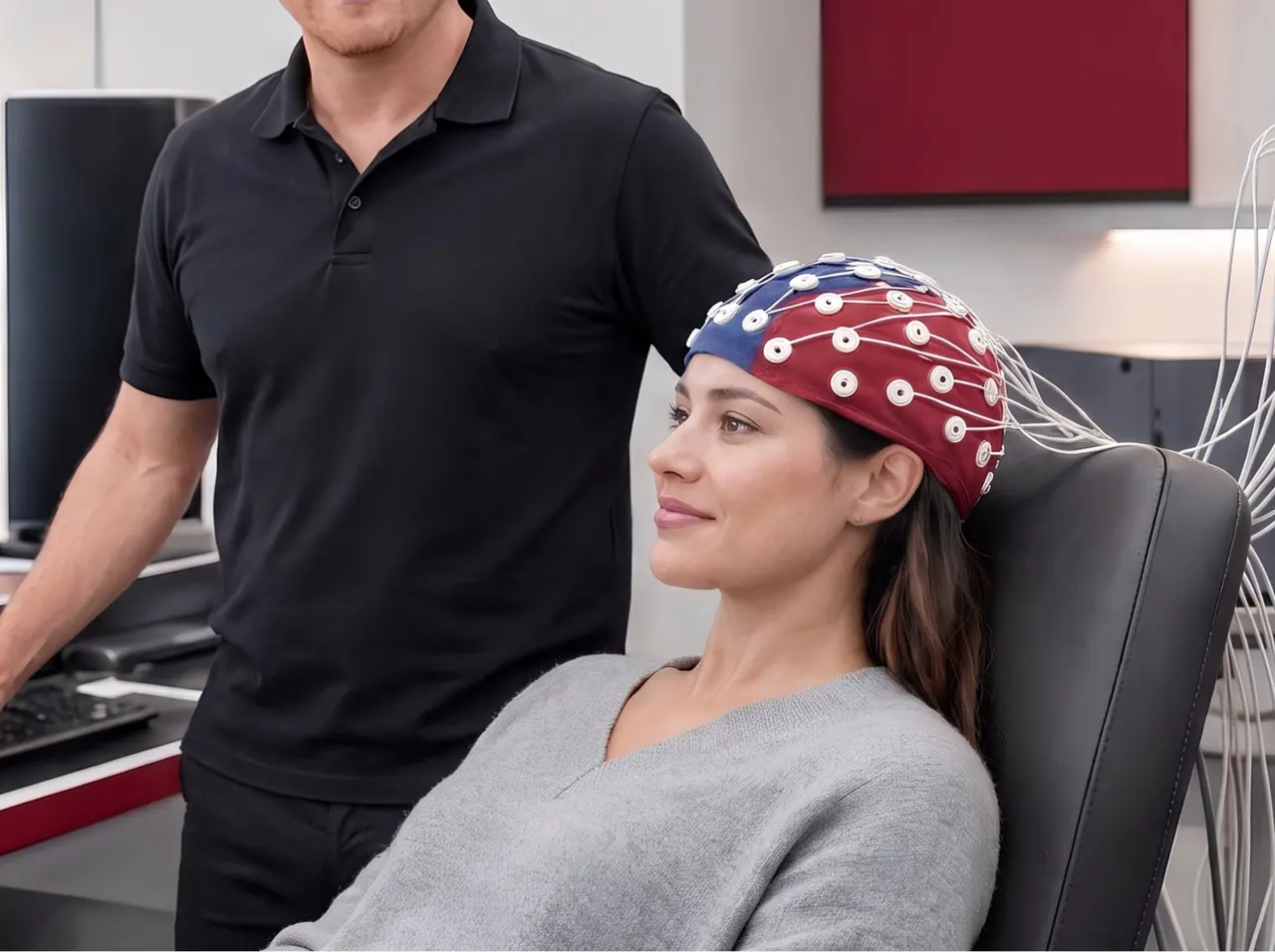
Live brainwave feedback helps you practice self-regulation when fatigue, sleep or attention are the problem. Read about neurofeedback for focus and fatigue after a brain injury.
Scalp sensors record brain activity to set up neurofeedback; it is not a stand-alone TBI test. Learn how a qEEG brain map guides training.
Rancho Santa Fe only
Light-board and screen tasks train visual scanning, reaction time and memory, scored every session. Explore DynaVision cognitive and reaction training.
Gentle pulses through the tongue are paired with balance, movement or thinking exercises. Read about TLNS for balance and movement after a brain injury.
When walking is affected, mild electrical input to leg nerves can be paired with gait practice. See nerve stimulation paired with walking practice.
Your options
| Option | What it involves | When it fits |
|---|---|---|
| Hospital and inpatient rehabilitation | A team of doctors, nurses and therapists | Right after hospital care for a moderate or severe injury |
| Outpatient physical, occupational and speech therapy | Scheduled therapy for movement, daily tasks, speech and thinking | Once you are home and ready for regular sessions |
| Medication from your physician | Prescriptions for pain, sleep, mood or seizures | When symptoms need medical care; we do not prescribe |
| True Performance program | Testing plus GyroStim, neurofeedback, DynaVision, TLNS and PNS | Balance, visual or thinking problems that remain, alongside or after therapy |
These options often run side by side. Your medical team leads medical decisions and medication, and our work complements your therapy rather than replacing it.
Recovery
Every brain injury is different. Here is what published guidance says about the general course, not a set True Performance schedule.
The first 24 hours
Seizures, unequal pupils, repeated vomiting or trouble waking need immediate medical attention.
Hours to days
Some damage develops over hours to days, so prompt trauma-center care matters for serious injuries.
A few weeks
Most people recover fully from a first concussion within a few weeks. Recovery from a second or third concussion is generally slower.
Months to years
These injuries can lead to long-term health problems, and rehabilitation may be needed over the long term.
Sources
Red flags
Some signs after a head injury mean emergency care comes before anything else.
If you notice any of these after a head injury, call 911 or go to the emergency room right away.
Source: National Institute of Neurological Disorders and Stroke overview of TBI.

Your clinician
Your care is planned by Dr. Jeff McWhorter, D.C., a chiropractor whose practice focuses on functional neurology, concussion rehabilitation, and performance. He works with people regaining balance, coordination and cognitive performance after a head injury, often in coordination with their medical providers.
He reviews your records and current restrictions, then builds a plan that fits the therapy you already have. When something needs medical attention, he sends you back to your physician.
Visit
Our office is at 18029 Calle Ambiente, Suite 507, in Cielo Village, Rancho Santa Fe, about two miles from Lake Hodges. Patients and families come from across San Diego County and beyond, and we help with planning travel for rehab after a brain injury.
The first step
Many people recover fully from a mild injury, often within weeks. Moderate and severe injuries can cause long-term changes, though many people keep improving with rehabilitation. No one can promise a full recovery.
Families may notice irritability, impatience, impulsive reactions, low motivation or mood swings. Discuss new or worsening behavior changes with the medical team; mental health support can help.
Not necessarily. The brain can continue to adapt with focused practice, even years later. We test where you are now and tell you honestly what we think is realistic.
Yes, a concussion is a mild traumatic brain injury. Symptoms that linger after one are covered on our page about concussion and post-concussion symptoms.
Yes. Our work complements care from your physician, neurology team and therapists, so bring your reports and restrictions.
Journal
Start with a complimentary 15-minute call with our team.