
Contents
You stepped off the cruise ship days ago, yet the floor still seems to sway. Lying in bed feels like floating on water, and oddly, a car ride is the only time you feel normal.
That pattern has a name: Mal de Débarquement syndrome, or MdDS. This guide explains why the rocking lingers, who is most likely to get it, what research says helps, and where GyroStim motion training for lingering rocking fits.
What is Mal de Débarquement syndrome?
Mal de Débarquement syndrome is a rare condition that makes you feel you are moving when you are not. The feeling is usually rocking, bobbing or swaying rather than spinning. It most often starts after sea travel, though flights, long drives and train trips can trigger it too.
The name is French for sickness of disembarking. Many people feel a little unsteady for a few hours after a boat trip, which is normal.
MdDS is different because the feeling does not fade on schedule. The international criteria describe a rocking sensation that starts within 48 hours after the motion ends and lasts longer than 48 hours. When it goes on for more than a month, it is called persistent MdDS.
Why does the rocking keep going?
On a boat, your brain learns to expect constant motion and adjusts how it reads signals from your inner ear, eyes and body. Back on land, that adjustment should switch off. In MdDS, it seems to stay switched on, so the brain keeps producing a rocking sense that no longer matches reality.
Researchers are still working out exactly why this happens in some people and not others. One line of research points to the vestibulo-ocular reflex, which keeps your eyes steady when your head moves.
In that model, rolling motion on a ship retunes the reflex, and it stays tuned to the sea. The same studies used head movements and moving visual patterns to retune it again, which shaped later rehab approaches.
Keep in mind
MdDS does not usually mean the inner ear is damaged, and standard ear tests are often normal.
Why do I feel better in the car?
Feeling better during passive motion, such as a car ride, then worse when you stop, is one of the defining signs of MdDS. It sets MdDS apart from motion sickness, which gets worse in motion. It is part of the international criteria physicians use to recognize the condition.
It can feel strange to reach for the car keys just to feel steady. The likely reason is that real motion briefly matches what your brain still expects.
The relief usually fades once the motion stops. Standing still, lying down and sitting in a quiet room are often when the rocking feels strongest.
The full definitions are in the Bárány Society's consensus criteria for MdDS.
Who is most likely to get MdDS?
Anyone can develop MdDS, but about 85% of cases are women between 30 and 60. It is also more common in people who get migraines.
Some people develop it with no travel at all, for example after childbirth, surgery or head trauma. Stress, poor sleep and busy visual settings can make symptoms flare.
- Women between 30 and 60
- People with a history of migraine
- Travelers after a cruise, flight or long drive
- Some people after childbirth, surgery or head trauma
These figures come from Cleveland Clinic's guide to MdDS.
How do physicians confirm MdDS?
No single test confirms MdDS. Your physician first rules out other causes, such as vestibular migraine or an inner-ear problem, often with hearing tests, balance tests and sometimes imaging. The Bárány Society published shared criteria in 2020, so providers around the world use the same standard.
Start with your primary care physician. They may refer you to an ear, nose and throat doctor or to a physician who focuses on balance disorders, usually once symptoms have lasted about a month.
Bring a short diary of when the rocking is worse and when it eases. That pattern, especially relief in a car, helps your physician a great deal.
What does research say helps?
A 2023 review of 32 studies found reported improvement with several approaches, including specific vestibular rehabilitation programs, stimulation methods and some medicines. Motion sickness medicines usually do not help MdDS, because the problem is not motion sickness.
In one well known study, people rolled their heads gently while watching a moving visual pattern, a way of retuning the balance reflex. Seventeen of the 24 people had complete or substantial relief, and six improved at first before symptoms returned.
These results are encouraging, but they come from small groups. Any plan should be paced to your symptoms and set with your physician.
Those numbers come from a 2014 study in Frontiers in Neurology.
The overview of options comes from a 2023 scoping review in Otology and Neurotology.
Where does GyroStim fit?
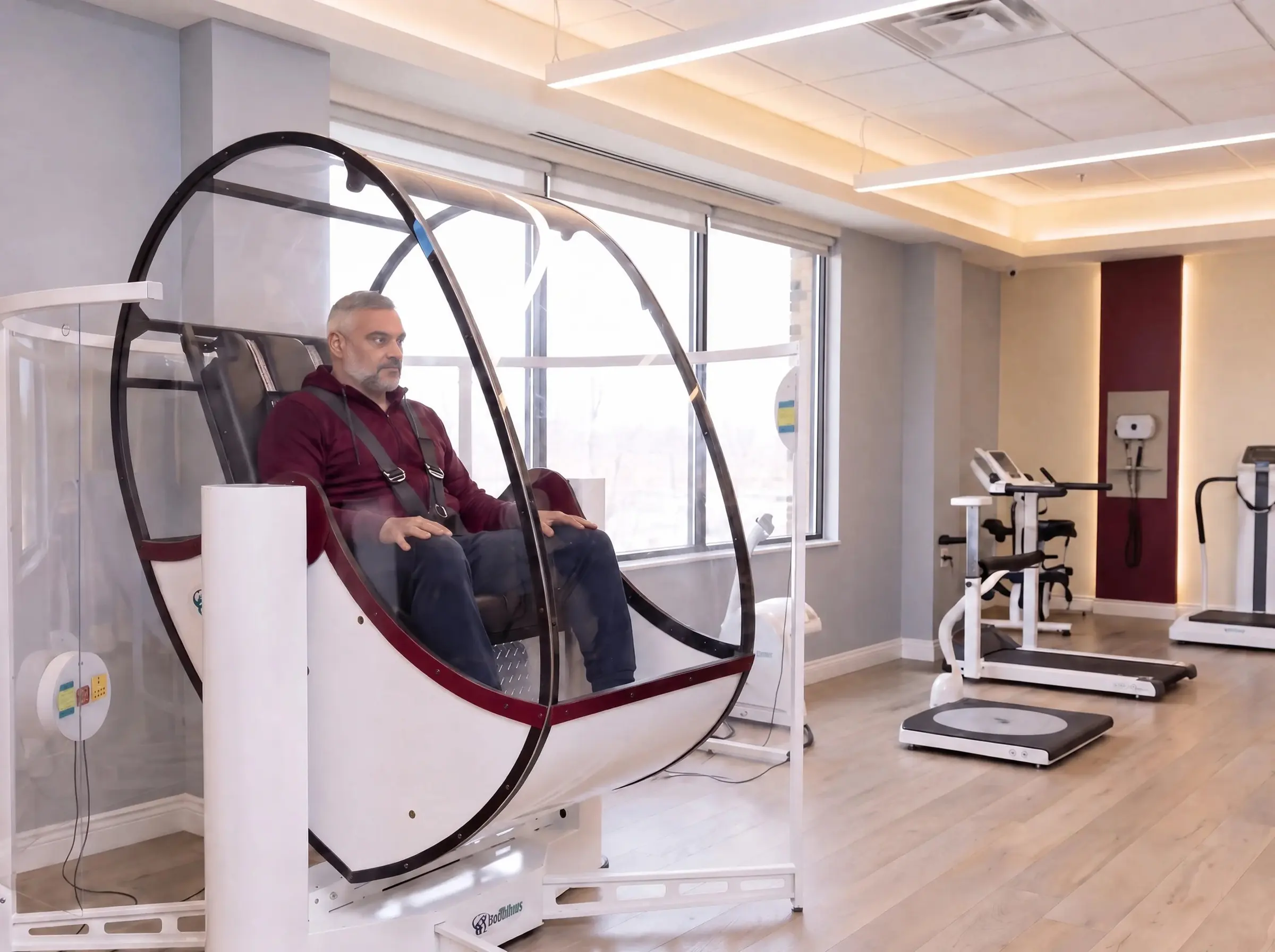
GyroStim is a computer-controlled chair that rotates you on several axes while you aim at lit targets. With MdDS, motion and stillness affect symptoms differently, so the chair lets us vary direction, speed and visual focus while watching how the rocking changes.
Dr. Jeff McWhorter, D.C., sets the protocol after a detailed evaluation, exam and review of your history. Sessions stay inside what you tolerate, and GyroStim is available at our Rancho Santa Fe office only. It is one of several tools at our neurological rehabilitation center in North County San Diego.
Keep in mind
GyroStim's FDA clearance covers balance disorders and vestibular dysfunction; other uses described here fall outside that clearance.
What should you do next?
If the rocking has lasted more than a few days, see your physician to rule out other causes. MdDS is real, it is recognized, and most people improve.
In the meantime, small habits can make flares less likely. Protect your sleep, break up long screen sessions, and note which settings bother you most, such as busy stores or long meetings.
Once other causes are ruled out, balance retraining can be part of the plan, in coordination with your medical team. You can read more about how we approach the rocking of MdDS, then start with a complimentary 15-minute intro call.
Frequently asked questions
How long does Mal de Débarquement syndrome last?
For most people, the rocking fades within a day. Most others improve within a year, though a small number have symptoms for months or even years.
Is MdDS dangerous?
MdDS can be exhausting, and it deserves a proper medical check. New symptoms such as a true spinning feeling, weakness, slurred speech or a sudden severe headache point to a different problem and need emergency care right away.
Will motion sickness pills stop the rocking?
Usually not. MdDS is a different problem from motion sickness. Some physicians use migraine, anxiety or sleep medicines when those fit, and that decision stays with your physician.
Is MdDS all in my head?
No. MdDS is a recognized balance disorder with published international criteria. Anxiety, fatigue and headaches can come with it, and they deserve care too.
Has GyroStim been studied for MdDS?
There are no large studies of GyroStim for MdDS. We use it when your exam shows it fits, measure how the rocking responds, and change the plan if your scores stop improving.
Get a plan for the rocking that will not stop
Start with a complimentary 15-minute call with our team.