
Contents
Hyperbaric oxygen therapy gets big claims online. Some posts call it a reset for the brain, others a shortcut to recovery. If you are weighing it, you deserve to know which claims rest on solid research and which do not.
This guide sorts the evidence into three groups: the accepted medical uses, the areas still being studied, and the risks. It ends with how we decide whether hyperbaric oxygen sessions fit your recovery plan at our Rancho Santa Fe clinic.
What is hyperbaric oxygen therapy?
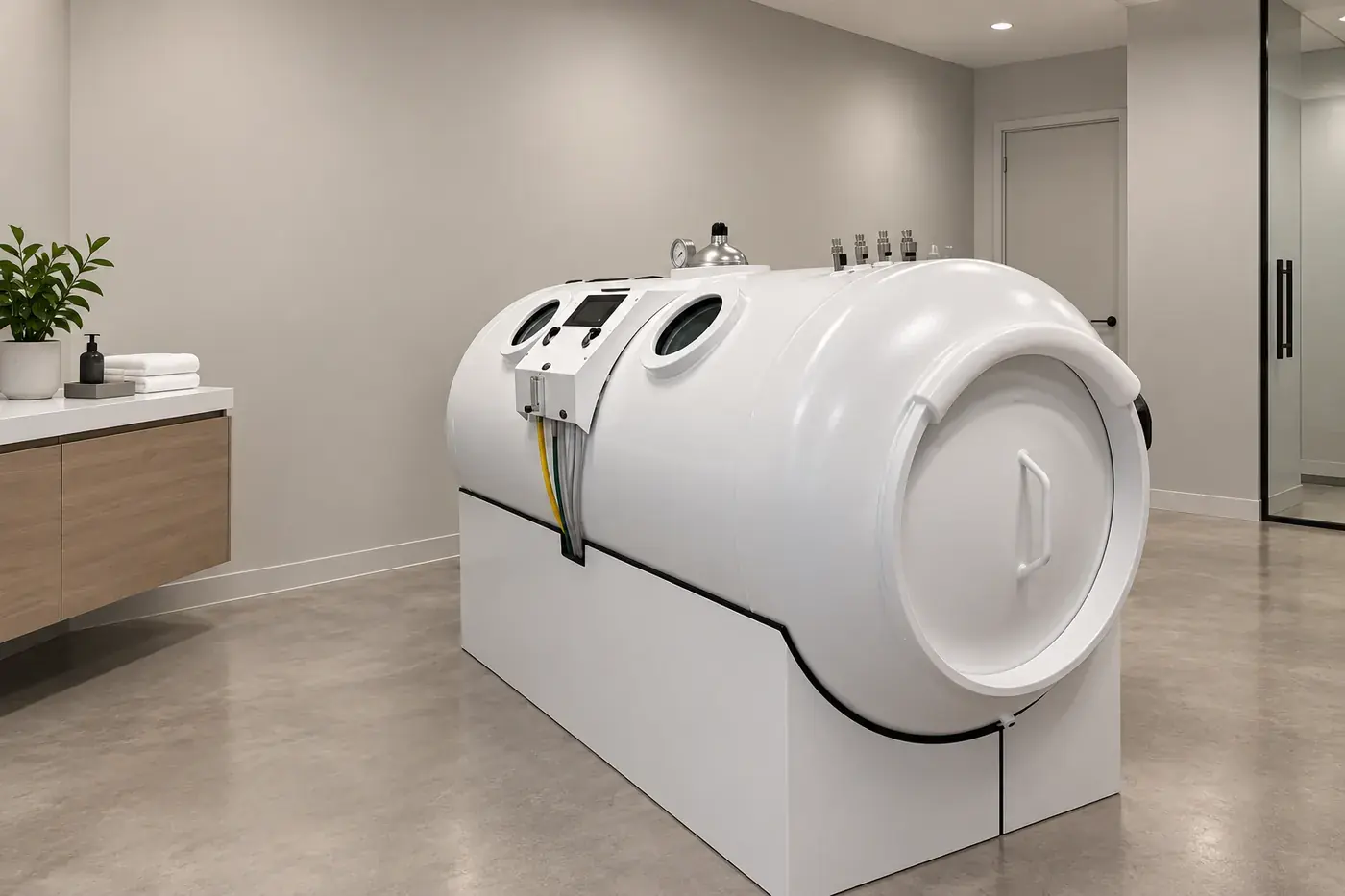
Hyperbaric oxygen therapy means breathing oxygen inside a chamber where the air pressure is raised above normal. The higher pressure lets your blood carry more oxygen to your tissues. Sessions take place in a sealed chamber, and you rest and breathe normally while the pressure rises and falls.
Hospital programs use HBOT for a defined set of medical problems. Wellness clinics, including ours, may also offer it as support alongside other care.
Those two settings are not the same thing, and the difference matters when you read claims online. A result from a hospital wound program does not carry over to a sports recovery session.
Which uses have strong evidence?
The Undersea and Hyperbaric Medical Society keeps a list of accepted uses. It includes decompression sickness, air or gas bubbles in the blood vessels, carbon monoxide poisoning, some wounds that are slow to close, radiation injury, severe infections of soft tissue or bone, and sudden hearing loss.
For these problems, HBOT is a medical procedure. The society describes it as prescribed and overseen by a physician, delivered in a hard-sided chamber, with sessions that often run 90 to 120 minutes.
Many of these uses are emergencies. If you have carbon monoxide poisoning or diving illness, go to a hospital, not a wellness clinic.
- Decompression sickness and air or gas embolism
- Carbon monoxide poisoning
- Selected wounds that are slow to close, and at-risk skin grafts or flaps
- Delayed radiation injury
- Severe soft tissue and bone infections
- Sudden sensorineural hearing loss
The full list, and the society's definition of the therapy, are on the Undersea and Hyperbaric Medical Society's indications list.
What does the research say about concussion?
Research on HBOT after a concussion is mixed. One sham-controlled military trial found that people who had HBOT and people who had a sham session improved about the same. Another trial, without a sham group, reported better thinking scores after HBOT. Concussion is not an accepted use of HBOT.
The sham-controlled trial followed 72 service members with symptoms months after a mild brain injury. Both chamber groups reported fewer symptoms than people who had no chamber sessions, which points to a strong placebo effect.
A 2013 trial of 56 adults, one to five years after a mild brain injury, reported better scores on thinking tests after 40 sessions. The comparison group simply waited, so the result cannot separate the oxygen from the experience of the sessions.
Keep in mind
For people working to regain balance, coordination and focus after a head injury, HBOT is never a replacement for rehabilitation or medical care, and we coordinate with their medical providers.
The military results were published as a sham-controlled trial in JAMA Internal Medicine in 2015.
The smaller study is the 2013 trial in PLOS ONE, which used a crossover design with no sham session.
What about stroke?
A Cochrane review of 11 randomized trials, with 705 people, found no good evidence that HBOT improves outcomes when given early after an ischemic stroke. Stroke is not an accepted use of HBOT.
The trials varied in quality, and a few disability scales moved in HBOT's favor. The reviewers still judged the evidence too weak to guide practice.
If you are working to regain balance, coordination and movement after a stroke, your core plan comes from your medical team. Anything added, including HBOT, should be discussed with them first.
The findings come from the 2014 Cochrane review of hyperbaric oxygen after ischemic stroke.
Recovery, fatigue and athletic performance
Athletes and busy professionals often ask about HBOT for recovery or low energy. None of these appear on the accepted list, and good controlled studies are scarce.
That does not make every session useless. It means any benefit is personal and unproven, so we offer HBOT here as wellness support alongside your other care, never as the plan itself. We check how you feel and function as sessions go on, and we stop if HBOT is not adding anything.
Is hyperbaric oxygen therapy safe?
HBOT has real risks, even though serious problems are uncommon. The most common is ear and sinus pressure as the chamber pressure changes. Less often, people notice short-term changes in their vision, and rare problems include a collapsed lung or a seizure from too much oxygen.
Oxygen-rich air also raises fire risk. That is why phones, watches and other electronics stay outside the chamber, and why you wear cotton clothing.
People who use insulin can see their blood sugar drop during a session. Tell us about any lung condition, recent ear problem, cold, fever or pregnancy before your first visit, so we can check with your physician first.
These risks are described in more detail in Mayo Clinic's overview of hyperbaric oxygen therapy.
How do we decide whether HBOT fits your plan?
We start with your health history and safety questions, then look at the rest of your plan. HBOT is one of the recovery-minded services at our wellness center, and it only makes sense when it supports that plan.
Our sessions last about 60 minutes in a one-person hard-shell chamber, such as our Fortius F420. You lie back and breathe normally while the pressure rises slowly. Dr. Jeff McWhorter, D.C., also designs hyperbaric chambers, so our team knows the equipment closely.
What is the takeaway?
HBOT is well proven for a short list of medical problems. For concussion, brain injury, stroke and sports recovery, the evidence is mixed or negative, and none are accepted uses.
Before you book HBOT anywhere, ask a few plain questions. Which uses are accepted, and is mine one of them? How long is each session, and who oversees it? How will we know whether it is helping?
If you still want to try it, do it with clear goals, a safety check and a plan to stop if nothing changes. Start with a complimentary 15-minute intro call to learn what a hyperbaric session here involves.
Frequently asked questions
Is hyperbaric oxygen therapy approved for concussion?
No. Concussion is not on the accepted list of HBOT uses, and a sham-controlled trial found no clear difference between HBOT and a sham session. If you are in rehab after a concussion, HBOT can only sit alongside that rehab, planned with your medical providers.
How many HBOT sessions does a person need?
It depends on the reason. In hospital programs, carbon monoxide poisoning may need only a few sessions, while slow-to-close wounds can need 40 or more. At our clinic, there is no set number; we review how you feel and function and adjust.
Does HBOT hurt?
Most people feel ear fullness as the pressure changes, much like on a plane. Swallowing or yawning usually clears it. Tell us right away if your ears or sinuses hurt, and we slow the pressure change or stop.
Can I use HBOT if I have a cold or an ear problem?
Usually not until it clears. A blocked nose or a recent ear injury makes pressure changes harder and riskier. We wait, or check with your physician, before your first session.
Does insurance cover hyperbaric oxygen therapy here?
We explain cost and payment options on your intro call, before you book any sessions. Questions about your own coverage are best asked of your insurer.
Find out whether HBOT fits your plan
Start with a complimentary 15-minute call with our team.